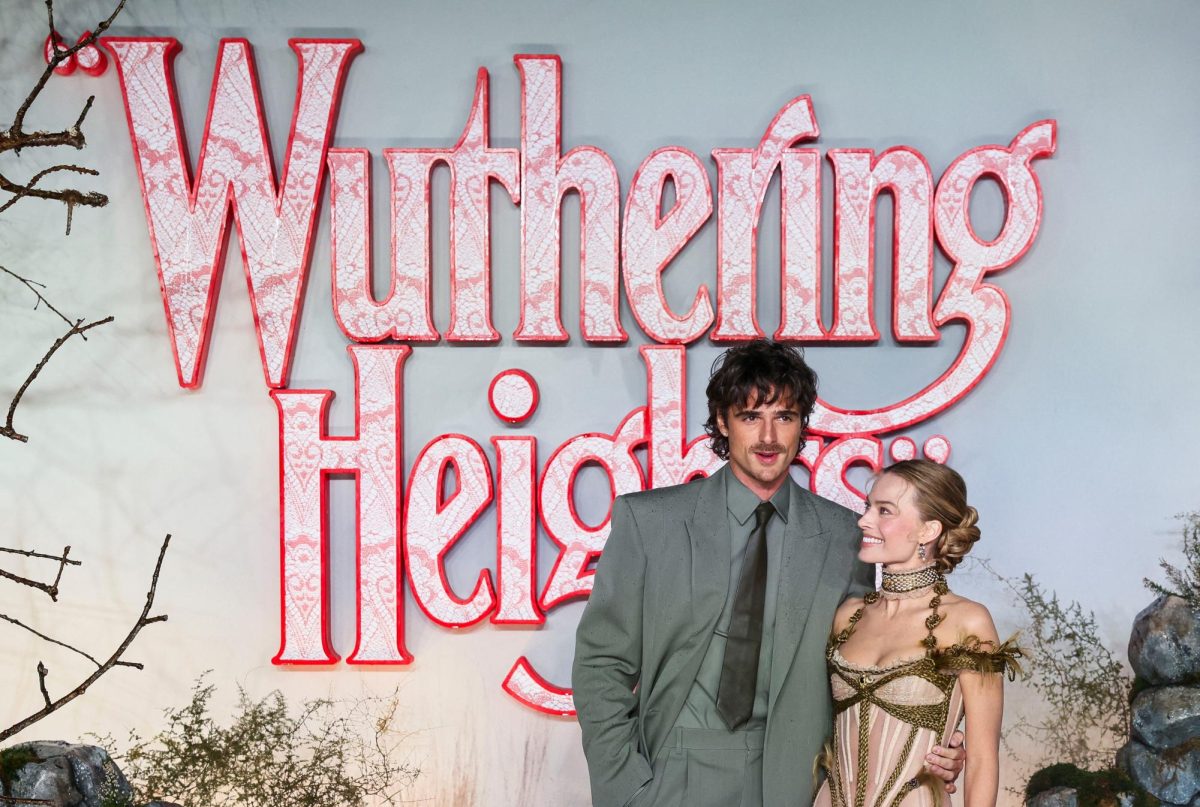
Emily Brontë’s novel Wuthering Heights has received a film adaptation done by director Emerald Fennell, starring actors Jacob Elordi and Margot Robbie, which was released over Valentine’s Day weekend. Taking as many creative liberties as possible, the film creates a “stylized” version of the original story, and has raised a high volume of debate on if it destroys the intentions of the source material.
Emerald Fennell has always seemed entirely self-serving as a filmmaker. Fennell has two other major film credits: Promising Young Woman (2020), and Saltburn (2023). When looking at Wuthering Heights, Saltburn can be predicted to hold the most parallels. The film caters to the generation of privileged consumers who simply do not care–shots that look pretty alone, but don’t fit edited with the rest of the film, scenes created for shock value and therefore social media virality, and the kind of built in explanations that make audiences think “Did they really expect us to not understand that?” Saltburn created this fake lens of a deeper meaning, but, in reality, shied away from making any real claim on identity politics, despite that being what the film alludes to there being.
Fennell is a wealthy, white woman. She’s been able to break out into the film industry with her mediocre writing, as long as a shot or two look like they could be a laptop wallpaper. Getting away with shallow, self-indulgent filmmaking is a lot easier when you have a parent with a blue name on Wikipedia, and Fennell is proof of that.
This Wuthering Heights adaptation was never meant to be a representation of the book; it was intended to be a fantasy production. A major critique of the film has been the casting of Heathcliff, who is being played by Jacob Elordi. In Brontë’s Wuthering Heights, it reads “But Mr. Heathcliff forms a singular contrast to his abode and style of living. He is a dark-skinned gipsy in aspect, in dress and manners a gentleman…” The character of Heathcliff also says “I wish I had light hair and a fair skin, and was dressed, and behaved as well, and had a chance of being as rich as he will be!” Both of these quotes allude to Heathcliff being a person of color, which goes against the casting. Race comes to be a significant theme in the novel, so disregarding this is a major fault done by Fennell.
On the topic, the director has stated “The thing is everyone who loves this book has such a personal connection to it…I don’t know, I think I was focusing on the pseudo-masochistic elements of it…The great thing about this movie is that it could be made every year and it would still be so moving and so interesting…There are so many different takes…I think every year we should have a new one.” The quote can be boiled down to that, as a white woman, Fennell read Heathcliff as white, and therefore believed she should portray him as such.
Secondly, with more and more promotional material being released, the question of design arises. Emerald Fennell, lead actress Margot Robbie, and costume designer Jacqueline Durran have come out to say that the project was meant to be a “fantastical fever dream.” Costumes are experimental, containing a multitude of historical inaccuracies, modern music is used, and the production is generally designed to be outlandish. Creative freedom is a necessary part of filmmaking; however, when it comes to adaptations, when does it go too far?
Art conveys meaning. Changing the costuming, toying with the cinematography, and, most likely, modifying plot points, wrecks the meaning originally created in Brontë’s Wuthering Heights. This was never a light, fun, or fantastical story, and therefore should have never been the subject used as a playground. Saying ‘you people hate fun’ in response to criticism does not work when dealing with something that shouldn’t be boiled down to fun. Stylized adaptations have worked in the past, but they need to benefit the original work. This film benefits nobody other than director Emerald Fennell.