Gen Z and Gen Alpha are beginning to emerge in a surprising music demographic like never before: punk rock. All over the internet, there seems to be a revival of garage/basement band culture, bringing together thousands of loud, passionate youth who are ready to perform anywhere and anytime they can. Historically, music has been a place where people express and discover themselves, especially in the genre of punk.
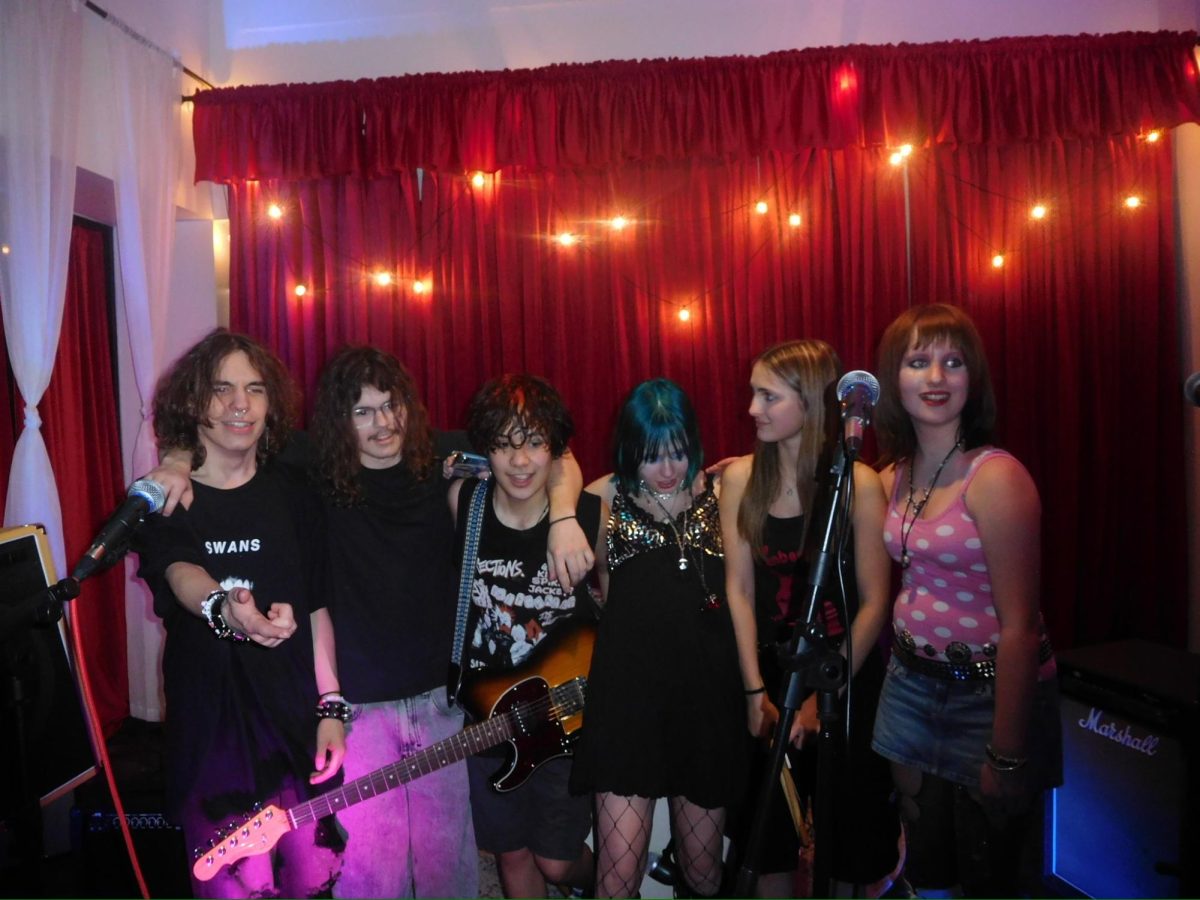
Here in Syracuse, there is a new voice ready to join the mix. Ice Holez is a teen punk band, and the only current Riot Grrrl band in the area. Their story and dedication to their messaging has shown the artistic brilliance of the new generation, and has the potential to reshape the local youth rock scene. This interview follows the four members of the band as follows:
Hope: Lead singer. 9th grader from Fayetteville-Manlius.
Olivia: Drummer. 10th grader from Fayetteville-Manlius.
Jules: Bass, backing vocals. 6th grader from Jamesville-Dewitt.
Lee: Guitarist, backing vocals. 9th grader at Jamesvillie-Dewitt.
The official transcription has been altered for clarity and to condense the article, responses follow a chronological order. Riot Grrrl refers to a subgenre of punk that highlights female bands and the feminist movement.
If you were to describe your band’s “vibe” in three words, what would they be?
ALL: “Feminism, outspoken, teenagers!”
How do you guys think the newer generation’s culture has changed or fused with the punk scene?
JULES: “I think that the modern punk scene is a lot more inclusive, especially in the Riot Grrrl scene. There’s a whole lot less racism, a whole lot less homophobia, transphobic people in the scene.”
HOPE: “It’s definitely for the better, and I think that we are some good examples of that.”
What do you think being a Riot Grrrl band means in this day and age?
HOPE: “I think it means to be inclusive to everyone. That everyone deserves a spot in the punk scene, and to enjoy the music and be in a band, and it doesn’t matter who you are.”
JULES: “I feel like it represents some form of rebellion towards conformism in the modern world. That’s what this band really means to me.”
LEE: “Not only is Riot Grrrl a specific genre of music where it’s a female dominated scene, like female dominated music and bands, it’s also turning the tables of [where] the people that were once less advantaged can now be on top of the pyramid.”
Being so young, how has it affected interacting with your industry peers? What are some pros and cons?
JULES: “Some of the pros are that it gives us a lot of publicity, because we’re this new band, we’ve got a different sound from most of the other bands in this scene, and we’re just this breath of fresh air to a lot of other bands. But on the other hand, there are a lot of cons that come with it. We have to worry about perverts in the scene, we have to worry about people not giving us gigs, or treating us differently because we’re so young, and not treating us like an actual band.”
Now that your band has been around for half a year now, what are some lessons you have learned?
HOPE: “It’s a lot of money for not a lot in return! Normally you make exactly as much as you put into it, and you need good equipment if you don’t want to use someone else’s PA [sound system]. Also, just don’t rely on other bands to bring stuff for you.”
JULES: “What I think we’ve learned is how to become more self-reliant. On getting gigs, on getting our own gear to shows, figuring out everything on our own. There’s no parents involved in the band specifically, they help us move things around ‘cause none of us can really drive yet, but that’s basically it.”
Would you say this teamwork has really strengthened how you guys play?
OLIVIA: “And all of us, each of us do our own thing independently but it seems to mesh together so well. And when we do eventually all come together, it just works.”
LEE: “We’re all on a similar wavelength when it comes to writing music.”
What are some of your favorite songs and musicians and how do they influence your work?
HOPE: “I feel like we have to start with Bikini Kill! The first song we ever played when we started the band, I had decided ‘everyone learn Rebel Girl by Bikini Kill’. Because it’s an easy song to play, and it just kind of sums up the genre all together. It was like the anthem for Riot Grrrl. So I decided we needed to learn that before anything else to figure out if we sounded good together.”
How do song ideas come to you?
HOPE: “I think the lyrics are very important. Most of the time I write my lyrics in social studies class…but like when we talk about the political aspects, I always take stuff from that and put them into writing.”
Do you guys have any plans for releasing music? I know you guys have two songs up on Spotify.
HOPE: “June 14th we’re recording a three song demo at School of Rock. I’m excited, but also really nervous though, because we’ve never professionally recorded anything.
Punk is known to be a culture that’s beyond just music. How do you think being musicians in the genre has affected your life?
JULES: “It’s made my political view go deeper than just, ‘oh, orange man bad,’ ‘bad MAGA bad,’ to actually having reasons and caring about what’s going on in the world, and caring about politics.”
HOPE: “I think if you’re going to be in a punk band, you have to be aware of the world around you to a point where you can talk about it and it makes sense.”
LEE: “I feel like I’ve become more self aware, and more willing to learn about what’s happening, because I went from like absolutely no media exposure to involving myself to the political part of the punk scene as well…because I was so sheltered in my childhood, it was just so strange and foreign to me, learning about politics and expressing my beliefs about politics.”
Why do you think being in a band is beneficial for someone your age?
JULES: “I think that it gives kids a creative outlet outside of school and outside of sports. It’s a way of self expression. And it also teaches people our age how to be alive in the world and how to function, how to get our own money, how to spend our money wisely, how to do all these things that we’re gonna need when we actually reach the age of eighteen.”
HOPE: “Also, if your band is gonna work out and you’re gonna get gigs and everything, you have to be mature. Like it makes you more mature in what you do outside of the band too.”
LEE: “It also helps you bond with people and create a community around you with people that have the same interests as you, the same career.”
How did you guys get together as a band?
HOPE: “Me and Lee, we were sitting together at School of Rock. And I was just so desperate to start a band, ‘cause I just kept thinking about it.”
OLIVIA: “She had been wanting to start a band for years, we tried this many times.”
HOPE: “And then I was like ‘Lee, if I started a punk band, would you join it?’ and he was like okay…Oh yes, so I asked Jules first at this MTV cover band for her 11th birthday…then I was like ‘do you want to be in a band together, for Riot Grrrl and punk?’ because I was angry. Because in the Syracuse scene, there’re no Riot Grrrl bands. We’re the only one that I know of…And Jules was like okay, and Lee’s like okay, and then I asked Olivia…and she was like, ‘I’ll make it work.’ We were almost five and had a different drummer.”
OLIVIA: “But we’ve stuck together, it’s really nice.”
Being in Syracuse, what are some things that you think are unique to the punk scene here?
HOPE: In the 90’s, Syracuse had the best hardcore scene, it was a very very strong scene. There were a lot of people, which is shocking ‘cause it’s not that big of a town…and then it just kind of fizzled out. And now, they’re trying to revive it, and it’s working in some ways, but not also not. Like the teen scene is so separate from the adult scene. And there’s not a lot of teen bands, and if there are, they’re all in college.”
JULES: “And I feel like we might be a bridge between the teen and adult scene because we’ve had gigs with bands from the adult scene…and we’ve had shows with people in the teen scene, and that has kind of created a bridge…and a lot of other bands that we’ve played with before that are primarily in the teen scene are now starting to communicate more with people in the adult scene.”
What do you think is the most meaningful part about being in this band?
OLIVIA: “Each other.”
For the members who attend FM, FM has a strong presence in terms of traditional music. What do you guys hope to bring to the school community with your band?
HOPE: “I think that the bands at our school are pretty much just cover bands…and I feel like I want them to expand more and try to make their own music…I feel like that’s very important and I feel like not enough people are doing it.”
OLIVIA: “I mean, I’m in [school] band, jazz band, swing stuff and it’s all fun, but this just brings a whole new thing to the table and I love to see it. It’s really fun.”