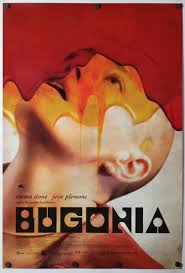
The unstoppable duo has returned; actress Emma Stone and director Yorgos Lanthimos have yet again created a critic-rave of a film highlighting the unique elements of their artistry. Their previous partnerships resulted in the Oscar-sweeping movie Poor Things (2023), as well as Kinds of Kindness (2024). Lanthimos has a curious style to his storytelling that Stone brings to life through her acting, and Bugonia (2025) is nothing short of these expectations.
You may wonder why the title is spelled as it is, and no, it has no direct relation to the flower species. It refers to an ancient Greek belief that bees could be produced out of the carcass of a cow. The motif of bees and their systematic hierarchies are crucial to understanding the film, and it is strategically not fed to the audience. There is an ambiguity behind the vibrant visuals and surrealism Lanthimos is known for, leaving most of the film up for interpretation. Though it is technically a remake of the Korean sci-fi cult classic Save the Green Planet! (2003), it incorporates many artistic liberties.
The general plotline takes endless turns and deceives the audience at every opportunity. When Michelle Fuller (Emma Stone), the CEO of a pharmaceutical company called Auxolith, is taken hostage by two young men named Teddy (Jesse Plemons) and Don (Aidan Delbis), viewers are presented with the difficult choice between determining which characters are in the right. While Michelle is portrayed as an executive opportunist, Teddy seems to be a bit of a nut-case. Convinced that Michelle is an alien, supposedly because she is unlike the rest of the human race, he convinces the innocent Don to play along in his scheme. Riddled with conspiracy theories and plot twists, Bugonia opens with the jarring juxtaposition between a rural American home, the morning routine of an ultra-wealthy corporation owner, and commentary over a bee pollination montage. Each actor holds a distinct character, with each of them being a crucial part of the storytelling process. The symbolism in this film is mind-blowingly complex, and calls for great post-viewing discussion.
When Auxolith tests an experimental drug meant to combat Teddy’s mother’s (Alicia Silverstone) opioid addiction, she is sent into a coma, leaving a young and vulnerable Teddy to fend for himself. Though Michelle provides his family with reparational payment, nothing can replace the absence of his mother figure. Ironically, the work Teddy picks up is a low-level, blue collar job packing boxes at none other than Auxolith.
Through his interaction with coworkers, we get glimpses into his reasonable resentment of the company. When an elderly woman working alongside him laments about how she got injured on the job and could not take time off, Teddy immediately jumps at the chance to comment about this injustice. Stories like this are easily relatable to instances in real life, as around 27% of the American workforce is filled with blue collar workers according to Pew Research Center. In that same study, these workers tended to show higher levels of negative self image, stress about wages, and have limited opportunities in the workplace. Even within the administrative workspace of Auxolith, the employment hierarchy is evident and intimidating. Stone plays the stoic Michelle in the corporate throne of her office, ensuring that the company meets the proper quotas.
This is where the bees are most prevalent in the story. Teddy describes to Don in the opening monologue the importance of ranks in the beehive. There are worker bees, and there is a queen bee. A change made by Lanthimos that diverges from the source material is the incorporation of a woman as the kidnapped CEO. This highlights the significant metaphor of bees, with Michelle being the “queen” rather than the original male character. On top of that, there is a gender hierarchy that is utilized to make the audience initially connect with Michelle.
In addition to Teddy’s history with Auxolith, he believes that his beehives are suffering from CDC, also known as colony collapse disorder, caused by the environmental damage done by Auxolith. CDC is mentioned plenty of times in the film, and it is defined by the United States Environmental Protection Agency (EPA) as a phenomenon when worker bees desert their hives, causing the failure of the colony. Though no reason has been deemed as the official cause of CDC, scientists have hypothesized that pesticide poisoning is a probable culprit.
Just as its predecessor Save the Green Earth! was a commentary on toxic work culture and the climate crisis, Bugonia most certainly follows its suit. Lanthimos is a master at his craft, and has much experience with creating his own interpretation through his adaptations. In a time period where environmental preservation and global living cost inflation needs to be discussed more than ever, his dedication to spreading this crucial message is deeply necessary.
Teddy’s obsession with bees is an interesting perspective on the position of workers in production. CDC almost alludes to strikes and employee protests, though this can be up for various interpretations. When workers are unwilling or unable to do their jobs, this puts the employers at risk. Therefore, perhaps we as humans should take the time to mitigate possible issues before we are unable to stop the irreversible effects of collapsing from within. In one particular line, Teddy notes that, “We are not steering the ship, Don, they are,” with regards to Auxolith. This ominous warning is a lesson we can apply to the real world, and even take into our own lives.
During its beginning acts, this movie seems to be a whimsical story about misled characters and their absurd schemes. However, as it progresses, it begins to feel more and more like a psychological horror. This is not a film that is easily digestible or for the faint of heart. There are jumpscares and spikes in the soundtrack that will make your pulse race. The rest of the score is dramatic, and almost classical sounding, giving the countryside a feeling of grandeur. Lanthimos allows his artistic vision to speak freely, and it has led to this fantastic release that is extraordinary in every aspect. Details in the movie were well developed, even in the naming of Auxolith. Auxo- is a prefix derived from Greek meaning to grow or to increase, and the suffix -lith refers to a stone. Take note of even the smallest things, because in art, it is likely to be intentional.
In the midst of the gravity of the film, the marketing team helped bring a lighthearted amusement to the promotional campaign. Take a look at the links below for some fun internet Easter eggs!
Auxolith LinkedIn page: https://www.linkedin.com/company/auxolith/
Human Resistance HQ website: https://www.humanresistancehq.com