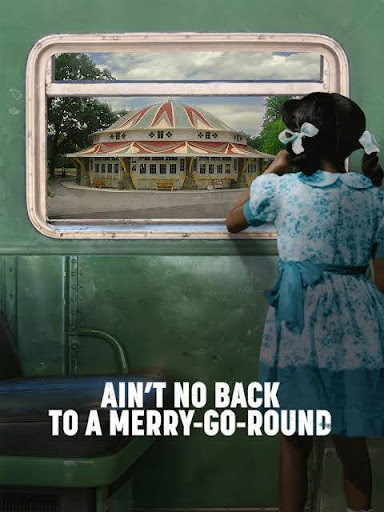
In consideration of current events, it is important to remember the power of solidarity. This Martin Luther King Jr. Day, I had the privilege of watching “Ain’t No Back to a Merry-Go-Round” with a post-viewing crowd Q&A with the director. The film touches upon the crucial allyship of the Jewish community during a protest during the Civil Rights movement, specifically concerning segregation in Glen Echo Amusement Park. Although the amusement park has now been turned into a national park, the impact of this student initiative will not be forgotten. Our world is actively allowing politics to divide, separate, and isolate people, and it is time for us to reach into history to find the blueprint of successful movements: mutual support.
Titled after a verse in “Merry-Go-Round” written by the acclaimed Black poet Langston Hughes, the film seems to perfectly reflect the themes brought about by Hughes in 1942:
Where is the Jim Crow section
On this merry-go-round,
Mister, cause I want to ride?
Down South where I come from
White and colored
Can’t sit side by side.
Down South on the train
There’s a Jim Crow car.
On the bus we’re put in the back—
But there ain’t no back
To a merry-go-round!
Where’s the horse
For a kid that’s black?
This effectively sums up about half of the film’s context. During the heavily segregated Jim Crow era, Washington D.C. and its surrounding areas in Maryland were no different from many of the deeper states down south. The well-loved Glen Echo Amusement Park was marketed as a fun getaway for families, filled with clear swimming pools, roller coasters, and the famous Dentzel Carousel. But just like institutions were during this period, this park was segregated.
Not wanting to lose profit because of racist ideologies, the park owners opted to keep Black Americans outside of their gates. A group of students from Howard University, a historically Black college, saw this as an issue that they wanted to take action on. Inspired by other student movements such as the sit-in protests sparked by the Greensboro Four, these students vowed to use the power of nonviolent protests to make waves. In fact, organizers had strict rules for people involved in their picket line to be nonresponsive to negative comments or actions taken against them. The students in the group were also involved in the Nonviolent Action Group (NAG), which was a student-led initiative at Howard created specifically to combat racism.
Dion Diamond and Hank Thomas, both founding members of NAG, used their connections at school to organize the beginning of the Glen Echo protests. Joined by various other students, the young men began to rally up their movement in early 1960. According to the official Glen Echo webpage, the summer this protest took place is often referred to as “a summer of change.” It was a powerful demand for reform, even at the cost of multiple protester arrests.
Although the students held great power through their passion and dedication, this would not be enough to put pressure on the owners. Catching the interest of a local neighborhood near the park called Bannockburn, the students quickly had new allies. The area was known for its large population of Jews, many of whom decided to take up arms with the Howard group. Even with their initial skepticism of allowing white supporters to join them, their integrated picket line grew substantially in numbers. In fact, they were often criticized for supposedly having more white picketers than Black! Eventually, their actions were able to persuade the Baker brothers (ironically both Jewish themselves) to let the park become integrated.
Even though the film serves as a thoroughly researched history lesson, it does not shy away from calling its audience to action. Throughout interviews with many of the protesters, we gain perspective on why people are pushed to speak up. For the Howard students, the reasoning is quite obvious. Their status as a targeted group by both racist ideologies and politics led their community to lead unequal lives compared to their white counterparts. For the Jewish protesters however, they remind us of the importance of empathy.
This quality not only led to their understanding of why these protests were taking place, but also why the Howard students were wary of their support. Even with the defeat of the Nazis in World War II, antisemitism was still rampant in the United States. Jews still faced discrimination and lived in extreme fear following the Holocaust. These events did not occur relatively too long before the Civil Rights Era. Their ability to recognize systemic violations of human rights was crucial to their participation. During the protests, the American Nazi Party even organized a counterprotest on the other side of their picket line. The Jewish community’s continued support was a brave statement of defiance for both minorities.
Director Ilana Trachtman, an Emmy award-winning filmmaker, was born into a Jewish-American family herself. Having parents who were also labor organizers, allyship between the Black and Jewish communities was not an unfamiliar concept. Growing up around the park, she was aware of its existence, but was not informed of the complexity of its existence until much later. She even stated that she had considered it as a wedding venue until a park ranger informed her of its history. She later explained how the national park made sure to include lessons about the key events that occurred, and that the park’s sister nonprofit acquired a grant for a walking tour of the picket lines. Interestingly, the park does also screen this film occasionally.
The questions from this Q&A session varied from technical storytelling to investigating current relations in the world. I was the first audience member to ask a question, and I inquired about an observation I made involving the Black Lives Matter (BLM) movement. Several clips of the interviewed protesters seemed to have merchandise displaying their support for BLM. She confirmed with me that the project was in fact filmed and edited during the peak of the movement, and that in reality, the whole film’s production process took her from 2014 to 2024 to complete. She explained that although it didn’t change the storytelling, the audience’s perception of the film changes with these events in hindsight. This is also why she did not have a singular narrator to give exposition, as she wanted to tell the story by highlighting the experiences of those who have lived through the event.
At the end of the Q&A session, one question addressed the nature of current relationships between the Black and Jewish communities. To this, the director responded with “The Jews, the Blacks. Who are they talking about?” in regards to categorizing people into groups. Her statement echoes many similar sentiments with these communities, including the inexistence of a monolithic community. She emphasized the importance of individual experiences and how this protest was able to grow because of personal relationships between group members.
Similarly, she recalled how keeping audiences informed is a crucial relationship that thrives even without institutional support. Through various questions about documentary making and funding, she clearly described how it is the role of storytellers to continue with their projects, despite setbacks. For her, challenges such as PBS passing on the film and a lack of streaming agreements made distribution difficult. Even with this in mind, she has had a very successful run in the film festival circuit and is now touring the country to share this story.
For future filmmakers, she explains how she used a mix of private and public funds. Some of the funders she had no longer exist, and she urges the private sector to stand up in order to help the people affected by the large cuts to public funding. She calls on people to continue documenting our time and staying creative now more than ever, and this film certainly shows her dedication for sharing voices.
Those voices who were featured in this film were the few that Trachtman was lucky enough to find. She wishes she had “started it 25 years earlier” because of the barriers she faced reaching the protest organizers and participants. From women changing their last names to memory related issues due to aging, she most certainly had her work cut out for her. Unfortunately, many of the protesters had died as time passed, and for some people, their families were not even aware of their participation!
There were some key takeaways from this film that function as advice to future changemakers. Many of the interviewed participants defined activism as “looking to the future.” The idea of activism is creating a better tomorrow using what you have today. They remind us of the power behind free speech, as well as the political importance of your body. Although we may feel small compared to a large world, we can create a huge difference together.
For more information, their website can be found here: https://www.aintnoback.com/