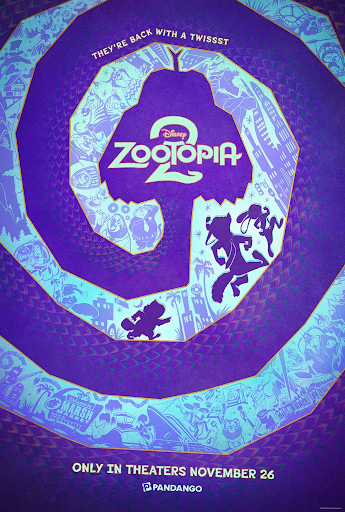
It has been approximately nine years since the release of Zootopia (2016). Nine years have passed where the initial audience consisting of kids have grown up, matured, and come to see the relevance of their favorite childhood movies. Zootopia is a classic Disney movie that serves as a clever metaphor for racial profiling, along with the troubling presence of misogyny in traditionally masculine jobs. Following the career of the rabbit Judy Hopps (Ginnifer Goodwin), Zootopia tells the motivating story of an underdog trying to make a name for herself in the city’s police department. It went on to win Best Animated Feature Film at the 89th Oscars, proving the magnitude of its impact. As successful as the first film was, it still came as a surprise to many people when the release of a sequel was announced. This project was announced in the February of 2023, though it had been in production long before. It is currently seen as an anticipated form of redemption for Disney, which has suffered major box office flops this year. So the question lies here: will Zootopia 2 (2025) be as well received as its predecessor?
Well to begin, Zootopia has an extremely loyal fanbase. Whether it is parents or kids, this movie has a universal message that can inspire anyone. The main themes of trial and error, persistence, and treating everyone equally is bound to create a community that will return for more. This hypothesis is now a fact for Disney as we walk into opening week for its sequel. According to Deadline, the film made $81.1 million dollars globally on its first day in theaters. The average rating on IMDB is currently 7.9/10 stars, just shy of the 8/10 stars for its prequel. These numbers show a strong correlation between viewers and their satisfaction with the movie. The film ensures that it does not throw away the integrity of the original work, making sure to keep beloved characters, while still adding to the domain of the old world. Additionally, it confirms some of the stories the audience hypothesized about at the end of Zootopia.
The movie begins like this: A newly partnered Judy and Nick Wilde (Jason Bateman) find themselves in trouble with the Zootopia Police Department due to their inability to work together. Though the two previously solved one of the biggest cases in the history of the city, they are constantly belittled at work after officially being assigned together. Nick’s witty humor and Judy’s drive for success do not seem to mesh well together, and they soon find themselves coiled up in a deeply fabricated plot against reptiles. If there is one thing that Disney excels at, it is the execution of impeccable plot twists. The entire movie is nearly unpredictable and had people in my theater at the edge of their seats. Please read on at your own risk, and understand that this film analysis is not possible without spoiling key moments.
The opening chase sequence is a fast paced banter between our heroes. It results in both protagonists making headlines for trashing the city, even though their objective was to catch a smuggler in an industrial shipyard. The media paints their epic purse in a negative light, and their luck only takes a turn for the worse as they decide to independently investigate the evidence of reptilian existence. During their visit to a ball with high publicity and notable figures, they run into their subject. It is a snake that goes by the name Gary De’Snake (Ke Huy Quan), and he is trying to salvage plans to save reptiles from total elimination. Although the snake is originally depicted as a villain, he turns out to be completely honest. On the other hand, a rich, powerful family of lynxes known as the Lynxleys prove to be a hateful group dedicated to keeping reptiles out of Zootopia. Judy and Nick are caught at the wrong moment, framing them at the event of poisoning of Chief Bogo (Idris Elba). Once again, they are not given a single moment to explain themselves, leading the news and city to label them as dangerous criminals.
In this narrative, we see the warnings the creators have indirectly spelled out for the audience. What this first segment of the movie discusses is the power of the media, and the control of the rich. Even though Judy and Nick held different intentions than what the news reported, the media severely misinformed the public about their actions. The work they were doing was never properly recognized, leading to conclusions that were outright false.
On the other hand, the Lynxley family was able to masterfully cover up their motives, and as it turns out, they had been doing so for decades. The Lynxleys were able to help animals buy their way into positions, as they did with Mayor Winddancer (Patrick Warburton). Winddancer is a puppet politician installed by the family to do their bidding without protest. Although he brings up that many of their actions are illegal, he does not have the ability to object. Do not worry, he eventually gets his chance at redemption. But this isn’t the lowest the Lynxleys stoop. Later in the movie, they admit to forcing the reptiles out of their homes under the guise of expanding the tundra district. Stealing a patent from Gary’s grandmother, the Lynxley family hoards undeserved credit for an engineering feat that defines Zootopia: the weather walls. The walls are a key aspect that allows various animal species to live together in such proximity, but ironically, the inventor of these intricate structures was cut out. This was because the Lynxleys deceived the elderly snake into a business deal, giving them access to the files they needed to alter. The film uses this to describe how sometimes the people appearing to help us are looking to control us.
There are several ways the corruption of the Lynxleys connects to our world. For one, the Lynxleys are an incredibly wealthy family, considering that they control aspects of Zootopian politics. These accusations are ones that are attuned to the current political climate of the United States, where politicians seem to have their campaigns backed by billionaires who want to see their interests preserved. According to OpenSecrets, a nonprofit organization dedicated to financial transparency in politics, Elon Musk donated nearly $300 million dollars in 2024 to the Republican party. Even with this clear financial backing, Musk has not been happy with its results. He is currently denouncing Republicans for passing bills with large spending and is even starting efforts to begin his own political party according to AP News. This certainly sounds like a mirror to our seemingly lighthearted movie, and it is important to view it as such.
Keep in mind that although this is introduced in a child-friendly manner, critical complexities should not be ignored. The allusions to ethnic cleansing and colonialism in the movie are abundantly clear, even on a surface level. What the Lynxleys subject the reptiles to in this film is unfortunately a repetitive truth in human history. The reptiles were not only forced out of their homes, but to go underground into hiding. A speculated fact confirmed in an official book released by Disney, The Art of Zootopia, states that only mammals live in the animated city. Although other species exist, the creators limited the metropolis to just mammals for easier production of the first film. However, the introduction of these new species provides a new spin on the story that makes it infinitely more complex. The reptiles inhabited a district that was eventually cleared to create more space for arctic mammals, forging a sense of empathy for the victims of forced removal. The instances where events like these have happened in our society are still repeatable offenses. That is why media with messages combating ideologies that may lead to them are especially significant.
A previous criticism for Zootopia was that it felt like pro-police propaganda. There are many legitimate arguments for this, but Zootopia 2 does not seem to fall into the trap of leaving this up for interpretation. The police force are distinctly working against our characters, and can even be seen as the main antagonist for portions of the film. Considering the controversy surrounding police in the last few years this project has been underway, it seemed to be a problem that was noted with more careful consideration. In the global scheme of things, police brutality is generally tied to oppressive or fascist regimes. Black Lives Matter is an example of a movement that arose from the distrust of unreliable law enforcement after the murder of George Floyd. Throughout both movies in the franchise, the police officers themselves are often a neutral force. The actions of the officers can lead to both dire or outstanding consequences, much like in real life.
Despite Disney’s current politics appearing regressive, Zootopia 2 takes stances that seem to defy its internal motivations. As Fox Business states, “Disney removed the terms “diversity” and “DEI” from its annual business report for the first time in five years…”, which certainly contradicts the company’s former policies. Formerly wrapped in issues such as defying the proposed Florida bill nicknamed the “Don’t Say Gay Law,” this seems to be a return to their old “woke” label. It currently seems unclear if they will move forward with a solidified political agenda, but it is important to note that this movie was developed before serious shifts in corporate management. Regardless of Disney, the franchise is a great introduction to hard conversations for kids as they mature.
Even with all the serious undertones, you do not have to fully approach this movie by searching for the deeper meaning. For one, the movie is great about explaining the mechanisms of a healthy relationship. Whether it be romantic, friendly, or even a cop partnership, the dynamic between Nick and Judy carries lessons on careful communication techniques. There are hilarious scenes of them in a therapy group specifically targeting police partnerships that have gone awry, and it most definitely a play on couples therapy. The two may go through rough patches, but they make up and go along with their journey, even maturing along the way. The plot finds time to carry in deliberate and well-placed jokes, while also creating references to real life through its nitty-gritty details. Much to the delight of audiences, Shakria returned to the cast and created a new song for the soundtrack. Keep your eyes open for any cameos and the delightful abundance of animal themed puns as you watch!
The question of whether or not a movie has a post credit scene is often asked, and I am here to tell you that Zootopia 2 does indeed have one. The clip begins with Judy replaying a voice memo on her carrot pen and annoying her neighbors. There is an argument between the characters that is a delightful callback to their interactions in the first movie. As she leaves the frame, a feather slowly falls down past the window, hinting at the possibility of another movie surrounding birds. Any information about this is currently all speculative, as no official statement has been released.
Overall, this film was absolutely exceptional, especially in terms of animated sequels. Zootopia 2 has pulled off what many fictional series have struggled with, and that is creating a story on par with its source material. Both movies have shown the complex structure of our society through a seemingly absurd and unrelatable world, appealing to audiences of all ages. In times like these, it is important that we ensure people understand what they are hearing. I am so grateful to have grown up with a series that reminds us our nature is just animal nature.