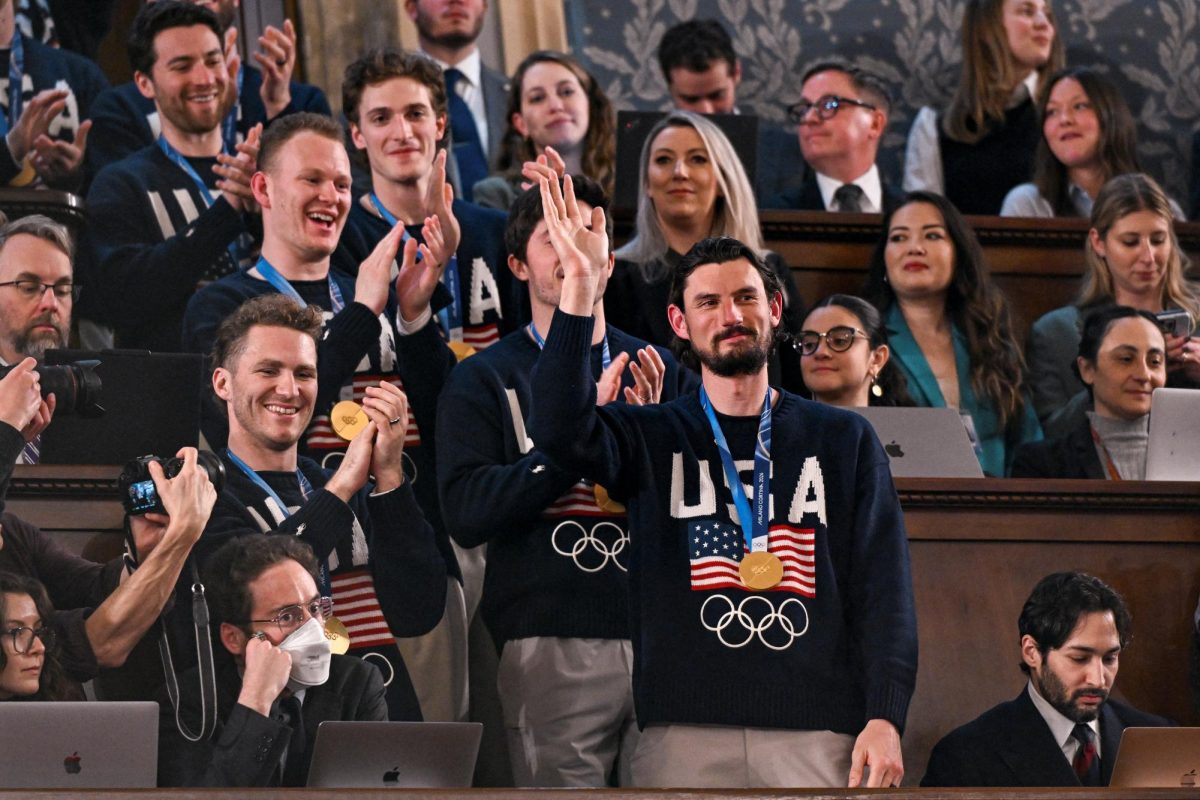
“[We’re] going to win bigger than ever. And to prove that point, here with us tonight is a group of winners who just made the entire nation proud. The men’s gold medal Olympic hockey team.”
U.S. President Donald Trump’s 2026 State of the Union address was held on February 24. The president gave the expected parts — updates on the economy, the security of the nation, and successes of the current administration. Key members of the administration were recognized for their accomplishments, and multiple presidential awards were given out.
However, one thing happened that was unprecedented. About twenty minutes into the speech, President Trump brought out the US men’s hockey team. As one of the many gold medal winners from this year’s Winter Olympics, a presidential visit was expected. But the nature of their visit was new to me, and in my opinion, represents a shift in the idea of patriotism in the United States.
Of course, I, like much of the United States, shared the feeling of widespread patriotism during the Winter Olympics. Watching Alysa Liu become the first American woman in 24 years to win a gold medal in women’s figure skating filled me with unmatched joy. Team USA breaking their record for the most gold medals (12) during a single Olympic games was truly amazing to watch.
However, the Olympics is not meant to fuel nationalism. Yes, watching your home country win should fill you with pride and a sense of patriotism. But the Olympics is also one of the greatest displays of global unity. In a guest essay for the New York Times, David Litt said that “the drive for excellence that the Olympics celebrate — and the courage, triumph, and heartbreak of the men and women who compete there — speaks to elements of the human condition that effortlessly cross borders.” The Olympics gives us a forum to connect over a love of sports, without any discussion of the struggling state of international relations today.
Yet it is hard to discuss sports without discussing politics. The Olympics have always had a looming air of politics. In 1936, the Berlin Olympics were used as Nazi propaganda. From 1964 to 1992, South Africa was banned from competing due to their apartheid policies. In 2022, Russia was banned from the Olympics for their invasion of Ukraine and remains so to this day. While the Olympics are a display of global unity, they are also heavily influenced by the state of the world.
As I cheered on the U.S. in the Olympics, another question arose: How can I celebrate our country when there is so much fear and uncertainty? Many U.S. Olympians were immigrants or the children of immigrants, and while they are congratulated by the Trump administration, many immigrants are being forcibly removed from the United States under orders from the same people who recognize the accomplishments of their athletic counterparts. Although I feel pride for U.S. successes during the Olympics, I can’t help but feel that I am slowly slipping into nationalism fueled by the sentiments of the Trump administration.
President Trump conflating the U.S. men’s hockey team’s win with the Trump administration’s actions provides a perfect example of patriotism being conflated with nationalism. From my perspective, the U.S. has not been meeting the standard of unity that the Olympics conveys. Threats to conquer sovereign nations and withdrawals from over 30 United Nations bodies are not forging unity; they are simply increasing the fear and polarization that our world is facing. The idea that the U.S men’s hockey team gold medal is one of many “wins” for our country politically turns a natural sense of patriotism into an artificial sense of nationalism that is very damaging to the United States and other nations.
Patriotism for the United States is not when the U.S. declares other countries inferior. Patriotism is when the U.S. is able to uplift other nations while achieving great things itself. It is when we acknowledge the fact that the U.S. is a nation built on the hard work and dreams of immigrants. Patriotism is when we don’t just raise our flag, but help other countries raise their flag, forging the unity that only the Olympics can bring in our divided world.